

.png)


Nic Zateslo Talks Cannabis Legalization, the MORE Act and AI Regulation on The Rotation
- Carlos Hermida

- 6 minutes ago
- 7 min read
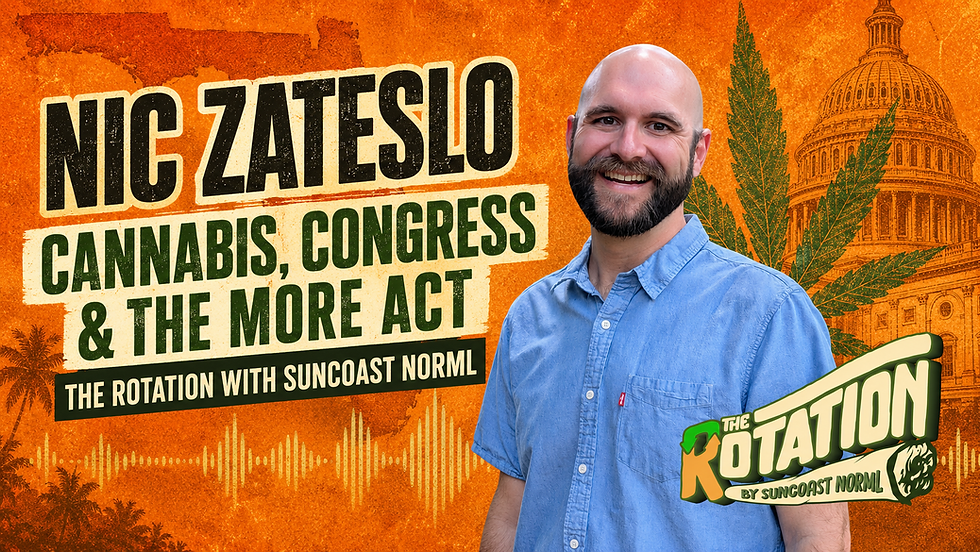
Florida’s Second Congressional District has an open seat, a crowded field of candidates and an opportunity to elect a new representative to Congress. On the latest episode of The Rotation with Suncoast NORML, Democratic candidate Nic Zateslo joined the podcast to discuss federal cannabis legalization, medical marijuana patient protections, hemp regulations, artificial intelligence and the future of North Florida.
Zateslo told the Suncoast NORML team that he would co-sponsor the Marijuana Opportunity Reinvestment and Expungement Act—better known as the MORE Act—and support ending federal cannabis prohibition.
“I would absolutely co-sponsor the MORE Act,” Zateslo said. “I am very much on the legalization of marijuana.”
The wide-ranging conversation also explored how cannabis policy intersects with economic freedom, social justice, small-business survival, emerging technology and personal privacy.
Who Is Nic Zateslo?
Nic Zateslo is a Democratic candidate for the U.S. House of Representatives in Florida’s Second Congressional District. The sprawling North Florida district stretches from the Tallahassee area to Panama City and includes all or part of 16 counties between the Georgia border and the Gulf of Mexico.
Zateslo grew up in Tallahassee, attended Rickards High School and later studied at the University of South Florida. During his time in Tampa, he became involved in Democratic politics, grassroots organizing and public-policy advocacy.
His professional background includes work with America Votes, voting-rights organizations, political campaigns and technology companies. More recently, Zateslo has worked in artificial intelligence and has developed policy proposals addressing AI governance, automation, data privacy and the environmental impact of hyperscale data centers.
The appearance also marked a reunion between Zateslo and Suncoast NORML Deputy Director Carlos Hermida, who knew him during their time at USF.
Zateslo Supports Federal Cannabis Legalization
When asked directly whether cannabis reform advocates could count on his support in Congress, Zateslo gave an unambiguous answer.
He said the ultimate federal goal should be the complete descheduling and legalization of marijuana—not simply moving cannabis from Schedule I to Schedule III under the Controlled Substances Act.
According to Zateslo, cannabis legalization touches nearly every part of American life, including:
Personal freedom
Economic opportunity
Criminal justice
Medical access
Employment rights
Small-business development
Zateslo said marijuana reform should not be treated as a strictly partisan issue. Supporters and opponents of reform exist in both major political parties, making coalition-building essential for passing meaningful legislation.
“The idea that, especially on an issue like marijuana reform, that this is a partisan split—it’s not,” he explained.
Why Zateslo Supports the MORE Act
The MORE Act would remove marijuana from the federal Controlled Substances Act and address some of the damage caused by prohibition. Although previous versions have passed the U.S. House, comprehensive federal cannabis legalization has yet to become law.
Zateslo said he supports the MORE Act because it addresses several interconnected issues instead of merely changing marijuana’s federal classification.
His stated cannabis priorities include:
Descheduling and legalizing marijuana
Supporting restorative justice
Addressing cannabis-related criminal records
Protecting medical marijuana patients
Preventing unnecessary employment discrimination
Creating a decentralized adult-use regulatory system
Protecting independent businesses from corporate monopolies
Zateslo acknowledged that Schedule III could represent an incremental step toward reform. However, he warned against allowing rescheduling to become the federal government’s final destination.
“I really want to make sure that we don’t put a flag down in Schedule III as the mandate, and then that gets stuck as a success,” he said.
Rescheduling alone would not create federal adult-use legalization, establish a national retail market or fully repair the damage inflicted by the war on marijuana.
Cannabis Legalization Must Include Restorative Justice
Legalization without restorative justice would leave millions of Americans carrying the consequences of conduct that is now legal in numerous states.
Zateslo said federal reform should consider people who were arrested, convicted or incarcerated for marijuana-related offenses. He also questioned the contradiction of allowing large cannabis corporations to generate millions of dollars while other people remain burdened by criminal records for participating in the same market.
The discussion reflected one of NORML’s central principles: Nobody should be arrested or punished simply for responsibly using cannabis.
Zateslo also emphasized that legalization should not merely replace prohibition with a tightly controlled market dominated by a few politically connected corporations.
“We need to make sure that we’re not just making it an industry-owned product,” he said.
Protecting Medical Marijuana Patients at Work
Medical marijuana patients can still face workplace discrimination even when they follow the laws of their state. A positive cannabis test may reflect marijuana consumed days or weeks earlier and does not necessarily establish that an employee was impaired while working.
During the episode, Zateslo was asked whether he would support protections for medical marijuana patients who face the possibility of losing their jobs. He connected those protections to the broader need for federal legalization and civil-liberties reform.
The hosts also discussed the numerous ways a person’s status as a registered medical cannabis patient may affect employment, law-enforcement encounters, health care and other areas of life.
For Suncoast NORML, legalization must involve more than allowing someone to purchase cannabis. Patients and responsible adult consumers should not have to choose between marijuana and their careers, medical care or civil rights.
Federal Hemp Regulations Threaten Small Businesses
The conversation turned to federal hemp policy and the uncertainty facing independent hemp retailers. Changes to federal law could remove numerous cannabinoid products from the legal market and threaten businesses that have operated under rules created by the 2018 Farm Bill.
Zateslo argued that federal hemp policy has developed without sufficient scientific research, public debate or consideration for the businesses built under the existing legal framework.
Instead of establishing a transparent regulatory process for hemp-derived cannabinoids, lawmakers have repeatedly relied on last-minute legislative language and arbitrary chemical thresholds.
Zateslo said Congress should invest in cannabinoid research through public universities and use that evidence to create rational regulations.
He also discussed the importance of distinguishing between products, dosages and intended uses. As with alcohol, cannabis products can exist across a wide spectrum—from low-dose products used by adults to stronger formulations used by patients with serious medical conditions.
“There is nothing I’ve seen that shows that adult use is a problem,” Zateslo said.
Preventing Cannabis Monopolies
Florida’s medical marijuana system has frequently been criticized for favoring a relatively small group of vertically integrated companies. Independent entrepreneurs face enormous financial and political barriers to entering the state-regulated cannabis industry.
Zateslo said marijuana legalization should produce a decentralized regulatory system that gives small businesses a meaningful opportunity to participate.
He expressed concern about policies that permit one or two large corporations to dominate cultivation, manufacturing, distribution and retail sales. Legalization should create economic opportunity—not simply transfer control of cannabis from the underground market to a corporate oligopoly.
His comments aligned with concerns raised during the episode about independent hemp businesses competing against large cannabis companies with greater access to capital, lobbyists and political influence.
Cannabis Privacy in the Age of Artificial Intelligence
One of the episode’s most distinctive discussions involved the intersection of cannabis policy and artificial intelligence.
Florida medical marijuana patients must provide personal information to participate in the state program. That information is stored digitally, raising questions about who can access it and how it could potentially be analyzed, combined or misused.
AI systems can process enormous databases and make connections that would have previously required substantial human time and effort. That creates new risks for medical marijuana patients whose information could potentially affect employment, insurance, policing, loans or government benefits.
Zateslo said government agencies and companies should not simply be trusted to use sensitive data responsibly. He supports enforceable guardrails, including records showing:
Who accessed personal data
When the information was accessed
Why it was used
What decisions were made
How an individual can challenge incorrect information
“I want to make sure that they’re forced not to abuse it,” he said. “I don’t want to trust them.”
Regulating AI and Data Centers
While cannabis policy was central to the interview, Zateslo’s campaign is also heavily focused on artificial intelligence and the rapid construction of hyperscale data centers.
He described these facilities as “AI factories” that can consume extraordinary amounts of electricity and water. Zateslo argued that the current generation of hyperscale data centers should not be built near communities without serious consideration of their impact on electric rates, water supplies, air quality and local infrastructure.
His proposed approach includes stronger AI accountability, greater transparency, investments in more efficient computing technologies and protections for workers whose jobs may be disrupted by automation.
Zateslo said citizens—not a handful of technology companies—should determine how AI is used in employment, policing, military operations and government decision-making.
Cannabis Reform Is About Freedom and Accountability
Zateslo’s appearance on The Rotation demonstrated how cannabis policy connects to some of the largest issues facing the country.
Federal prohibition affects personal freedom, employment, medical access, privacy, economic competition and the criminal justice system. Meanwhile, artificial intelligence could amplify existing discrimination if governments and corporations are allowed to use personal data without transparency or accountability.
For Zateslo, the solution begins with evidence-based policymaking and a willingness to work across party lines.
His stated position is clear: legalize and deschedule marijuana, support the MORE Act, pursue restorative justice, protect patients and prevent the legal market from becoming a corporate monopoly.
Watch or listen to the complete episode of The Rotation with Suncoast NORML for the full conversation with Nic Zateslo.
Suncoast NORML interviews candidates to educate voters about cannabis policy and other issues affecting their communities. An invitation to appear on The Rotation does not necessarily constitute an endorsement.
Frequently Asked Questions
Who is Nic Zateslo?
Nic Zateslo is a Democratic candidate for the U.S. House in Florida’s Second Congressional District. He is a Tallahassee native with experience in political organizing, technology and artificial-intelligence policy.
Does Nic Zateslo support marijuana legalization?
Yes. During his appearance on The Rotation, Zateslo said he supports federal marijuana legalization and descheduling.
Does Nic Zateslo support the MORE Act?
Yes. Zateslo said he would “absolutely co-sponsor the MORE Act” if elected to Congress.
What is Zateslo’s position on Schedule III?
Zateslo said Schedule III may serve as an intermediate step, but it should not replace the ultimate goals of descheduling and federal legalization.
What cannabis reforms does Zateslo support?
Zateslo supports legalization, restorative justice, medical marijuana patient protections, fair employment policies, independent cannabis businesses and regulations designed to prevent corporate monopolies.
What is Florida’s Second Congressional District?
Florida’s Second Congressional District covers a large portion of North Florida, including the Tallahassee and Panama City areas and all or part of 16 counties.


Comments