

.png)


Beyond the High: Why Cannabis Patient Education Matters in Florida

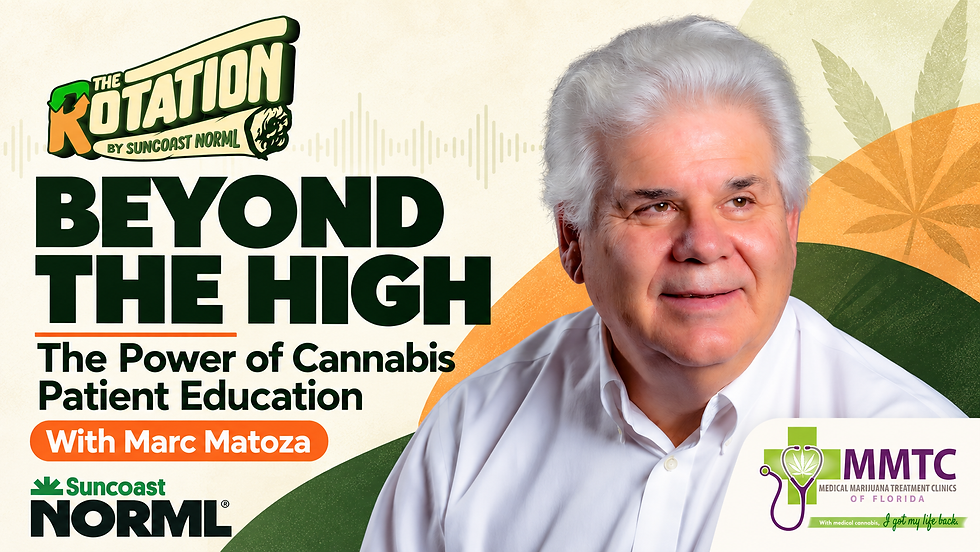
Marc Matoza joins The Rotation by Suncoast NORML to discuss dosing, seniors, product labels, and the questions patients need answered.
Getting a medical cannabis recommendation is one step. Walking into a dispensary and knowing what to ask for is another.
A patient might arrive looking for help with pain, worried about feeling impaired, and unsure whether an edible, tincture, or inhaled product makes sense. A menu full of creative strain names and THC percentages doesn't automatically answer those questions.
That gap was the focus of “Beyond the High: The Power of Cannabis Patient Education,” the latest episode of The Rotation by Suncoast NORML. Hosts Gary Stein and Christopher Cano welcomed Marc Matoza, founder of Marijuana Med Today and a host of Medical Marijuana Awareness & Wellness Webinars, for a conversation about helping patients understand their options.
Matoza put the problem plainly:
“Just because you have the capability of buying it doesn't mean you know what to buy, how to buy it, and how to take it.”
That is a pretty good description of why patient education deserves a bigger place in the cannabis conversation.
Patients Want Answers, Not Just Access
Matoza described a familiar pattern at his webinars: a relatively short presentation followed by a long question-and-answer session. People stay because they have questions that matter to their daily lives.
He said pain management, arthritis, and safety are recurring concerns. For many attendees, the question isn't how to find the strongest product. It's whether they can find relief while remaining comfortable, alert, and able to spend time with family.
Matoza also shared his own experience turning to medical cannabis after an automobile accident left him with persistent pain. He described finding an approach that helped him function without the level of impairment he had experienced with prescribed pain medication.
His experience is personal, and other patients may respond differently. But it illustrates the goal behind the episode: patients need information that connects product choices to their own needs and circumstances.
Seniors Need a Welcoming Place to Learn
Much of the conversation focused on older adults, including people returning to cannabis after decades away and people considering it for the first time.
Remembering cannabis from college does not prepare someone for a modern dispensary menu. Concentrates, capsules, tinctures, edibles, and devices introduce questions about strength, timing, and administration that deserve clear explanations.
Matoza said seniors made up a substantial share of the audiences at his early seminars. That shaped everything from the presentation to the room itself. He described widening aisles so people using walkers, wheelchairs, or canes could reach their seats comfortably.
That detail matters. Accessible education means more than making information available. People need to be able to enter the room, follow the discussion, and ask a question without feeling rushed or embarrassed.
The hosts and Matoza also discussed welcoming dispensary environments and the value of staff who can relate to patients across different ages and backgrounds. A patient who feels comfortable asking a basic question is more likely to leave with information they understand.
Dosing Is One of the Biggest Knowledge Gaps
Matoza identified dosing as a recurring topic in his educational work. Patients want to understand how much they are taking, what to expect, and how to evaluate their response.
That conversation needs to include more than a THC percentage. The amount consumed, route of administration, timing, and individual response all matter.
Edibles provide a useful example. The CDC explains that their intoxicating effects can take 30 minutes to two hours to become noticeable and may last longer than expected. Taking more before the first serving has taken effect can lead to overconsumption.
The practical takeaway is to establish a plan with a qualified clinician, understand the product's instructions, and avoid assuming that different formulations are interchangeable. A record of the product, amount, timing, benefits, and unwanted effects can also help patients have a more useful follow-up conversation.
“Do I Have to Smoke It?”
Another question Matoza hears frequently is whether medical cannabis must be smoked.
The episode explored alternatives, including tinctures, capsules, edibles, topical products, and dry-herb vaporization. Matoza described his own preference for using a dry-herb vaporizer and discussed how temperature affects the compounds released from cannabis.
The broader lesson is that patients need an explanation of their options. Different routes can have different onset times, durations, and risks. An edible does not behave like an inhaled product, and a topical product should not be assumed to produce the same effects as either.
Avoiding combustion does not make every alternative risk-free. Product quality, device characteristics, other medications, and a patient's health history still deserve attention.
Looking Beyond THC Percentages
Terpenes were a major theme throughout the interview. Matoza encouraged patients to learn more about product composition rather than choosing entirely by strain name or THC percentage.
That is a useful prompt to ask better questions. What cannabinoids does a product contain? What does its laboratory report show? Is the information specific to the batch being purchased?
However, terpene charts should not be treated as proven prescribing guides. Research into terpenes and the proposed “entourage effect” is ongoing, and clinical evidence does not establish a reliable terpene-to-condition matching system. Learning about composition can inform a conversation with a clinician; it cannot guarantee a particular therapeutic outcome.
Patients deserve education that explains both the possibilities and the limits of current knowledge.
Patients Should Be Able to Read the Label
Some of the episode's most practical discussion concerned labels that patients struggle to read.
Gary and Matoza talked about tiny print, fading labels, and difficulty finding product dates. Cano connected that discussion to the importance of transparency and patient access to meaningful product information.
A label isn't doing its job if a patient needs to photograph it and zoom in just to understand what they bought.
Patients should be able to identify the product's contents, serving information where applicable, relevant dates, and the corresponding certificate of analysis, or COA. They should also have someone available to explain unfamiliar terms.
A laboratory report can provide information about the sample tested. It does not, by itself, prove that a product will work for a particular condition or that it is appropriate for every patient.
Education Belongs Throughout the Patient Experience
The conversation also addressed dispensary staff training and the resources needed to deliver educational programs.
Matoza called for more support for patient education and acknowledged dispensary sponsorship of his events. The hosts raised questions about how consistently staff are prepared to answer patients' medical cannabis questions.
The opportunity is clear: education can continue after a doctor's appointment and beyond a purchase. Clinicians, trained dispensary staff, and educational programs each have a role, while medical decisions and medication-interaction questions belong with qualified healthcare professionals.
Cannabis is not harmless simply because a person has legal access to it. It can cause impairment and unwanted reactions, and it can affect how prescription medications work. Those considerations make education more valuable, especially for patients managing multiple conditions or medications.
From Patient Education to Cannabis Advocacy
In the Rotation Hot Seat, Matoza called for ending federal cannabis prohibition and encouraged the community to become better informed. Gary's Florida Man Minute and Cano's NORML News segment broadened the episode into a discussion of reform efforts, research, and political participation.
The connecting theme was informed decision-making. Patients need to understand their options. Voters need to examine policy proposals. Lawmakers need to listen to the people affected by the rules they create.
For Suncoast NORML, that is why these conversations matter. Access is more useful when people can understand it, navigate it, and advocate for improvements.
Watch “Beyond the High: The Power of Cannabis Patient Education” from The Rotation by Suncoast NORML, and explore Marc Matoza's educational events and recordings at MarijuanaAware.com. Bring your questions. That is where the learning starts.

Comments