

.png)


NORML News Round Up: Teen Cannabis Use Hits Record Lows as Reform Moves Forward

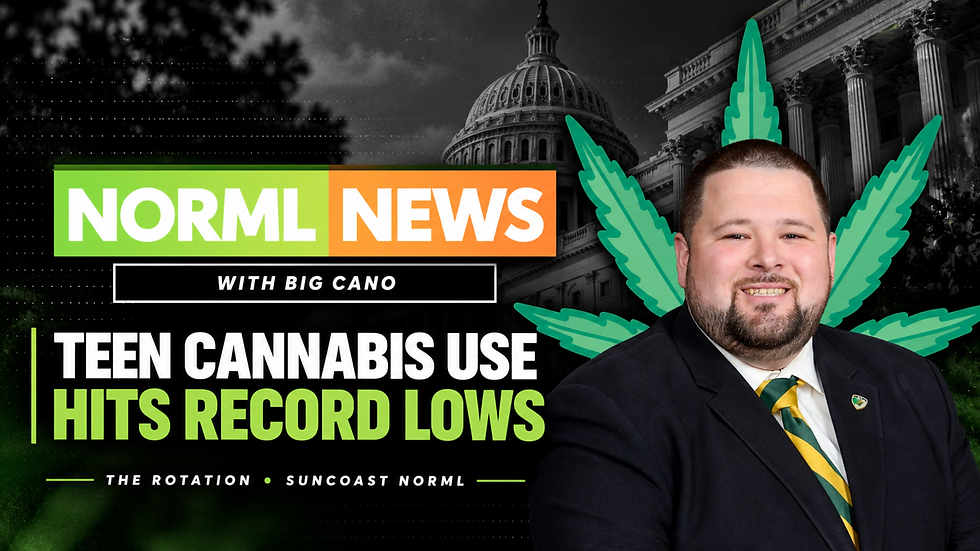
The Rotation’s latest news segment puts youth cannabis data in the spotlight, while Suncoast NORML’s weekly coverage explores patient care, federal reform, and the fight for fair treatment.
“What about the kids?”
It is one of the most familiar arguments against cannabis legalization. During the latest episode of The Rotation, our NORML News segment addressed that question with something more useful than another scare story: government data.
National NORML reports that high school cannabis use has fallen to historic lows as adult-use legalization has expanded. Meanwhile, this week’s additional Suncoast NORML coverage examines older adults’ cannabis use, medical cannabis patient experiences, gaps in nursing education, and federal proposals to remove barriers affecting workers and businesses.
Together, these stories make a case for cannabis policy grounded in evidence, education, and accountability.
This Week on The Rotation: Teen Cannabis Use Reaches Historic Lows
According to National NORML’s reporting on the latest CDC data, the percentage of high school students reporting current cannabis use fell approximately 60% over the past decade. Reported current use and lifetime use are now at their lowest levels in more than three decades. That decline occurred while nearly half of U.S. states established regulated adult-use cannabis markets.
That matters because opponents have repeatedly predicted that legalization would lead to more teenagers using cannabis. The national trend does not support that prediction.
There is an important distinction: these figures alone do not prove legalization caused the decline. They do demonstrate that expanding legal access for adults has coincided with falling youth use, rather than the nationwide increase critics warned about.
On The Rotation, we argued that regulation offers a better path forward than prohibition. Protecting young people should mean evaluating outcomes and strengthening safeguards—not repeating claims that the evidence fails to support.
National NORML deserves credit for bringing these findings into the public conversation and connecting readers with the underlying research.
Read our full story: Teen Marijuana Use Hits Record Low as More States Legalize Cannabis for Adults.
Beyond the Broadcast: Older Adults Describe Recreation and Relief
Our additional weekly coverage explored how older adults describe their own cannabis use.
A survey of 315 New York City adults age 65 and older found that 22.2% reported using cannabis during the previous year. Respondents described overlapping motivations, including enjoyment, relieving tension, improving sleep, and managing chronic pain. The survey also identified adverse effects and potential problematic use among some participants.
These findings describe a particular group recruited at selected locations; they are not a national estimate of older adults’ cannabis use or proof of medical effectiveness.
The broader lesson is that people’s reasons for using cannabis do not always fit neatly into “recreational” or “medical” boxes. Honest education should make room for those experiences while addressing risks.
Nursing Students Need Better Cannabis Education
When patients ask healthcare professionals about cannabis, they deserve an informed conversation.
An analysis highlighted in our coverage reviewed eight international surveys involving more than 3,100 nursing students. Fewer than half reported receiving formal cannabis education, and many felt unprepared to answer patients’ questions. Among U.S. students, fewer than one in five reported feeling prepared to answer questions about medical cannabis.
That gap matters whether a healthcare professional supports legalization or not. Patients already use cannabis and need guidance about potential interactions, adverse effects, and when to consult a pharmacist or prescriber.
National NORML’s reporting draws attention to a practical need: healthcare education should prepare professionals for the conversations patients are actually having.
Minnesota Cancer Patients Report Symptom Improvements
A report from Minnesota’s Office of Cannabis Management examined 6,621 patients with cancer-related qualifying conditions who purchased medical cannabis through the state program between 2015 and 2023.
Patients reported improvements in several symptoms after beginning purchases. Among those with moderate to severe symptoms at baseline, 39.9% reported at least a 30% reduction in nausea scores within four months, while 47.2% reported that level of improvement in vomiting scores. The report also documented side effects and significant limitations, including loss to follow-up.
These are patient-reported outcomes from an observational program analysis. They do not establish that cannabis caused every improvement or that cannabis treats or cures cancer.
They do provide useful information about patients’ experiences—information that deserves further study and careful discussion with treating clinicians.
Federal Cannabis Reform: Insurance and Employment Barriers
Two federal proposals featured in our weekly coverage address consequences of the conflict between state cannabis laws and federal policy.
The Clarifying Law Around Insurance of Marijuana Act, or CLAIM Act, would create federal protections for insurers serving legitimate state-regulated cannabis businesses. It would not require insurers to offer coverage, but it seeks to remove federal penalties tied solely to providing those services.
For Suncoast NORML, the principle is straightforward: businesses operating within state rules should have access to the services that help them manage risk and protect their operations.
The bipartisan Cannabis Users’ Restoration of Eligibility Act, or CURE Act, would prevent past cannabis use from being considered in federal employment suitability and security clearance determinations. It would also establish a process for reviewing certain previous denials. Both the CURE Act and CLAIM Act were introduced as proposals; introduction does not make their protections law.
The CURE Act raises another question about fairness: should someone’s cannabis history outweigh their qualifications to serve the public?
Cannabis History Meets Press Freedom
Our weekly coverage also followed an unexpected connection between cannabis culture and constitutional protections.
As High Times reported, founder Tom Forçade’s challenge to the denial of a White House press pass helped establish the history behind a precedent later known as Sherrill v. Knight. That precedent was invoked in the September 24 temporary order restoring White House credentials to CNN, MS NOW, and Politico. The order addressed due process and was not a final resolution of the dispute.
The story begins with Forçade’s famous “pie power” protest, but its lasting significance concerns government accountability: officials must follow a fair process when deciding who receives press access.
It is a reminder that the cannabis movement’s history reaches beyond the plant into broader struggles over civil liberties.
What These Stories Mean for Florida
The NORML News segment closed with a call to participate in the 2026 elections and carry that engagement into Tallahassee in 2027.
Our advocacy priorities include home cultivation, broader market access, and a regulatory approach that serves patients and consumers. Those are goals we must organize around and press lawmakers to address.
This week’s coverage shows why that work matters. Youth policy should respond to actual trends. Healthcare education should meet patients’ needs. Employment decisions should reflect qualifications. Cannabis businesses should be able to operate responsibly.
Watch The Rotation, explore the full stories linked above, and get involved with Suncoast NORML. We also encourage readers to support National NORML and its continuing work making cannabis research and reform news accessible.


Comments