

.png)


Insurance Industry Backs Federal Bill to Expand Coverage for State-Legal Cannabis Businesses

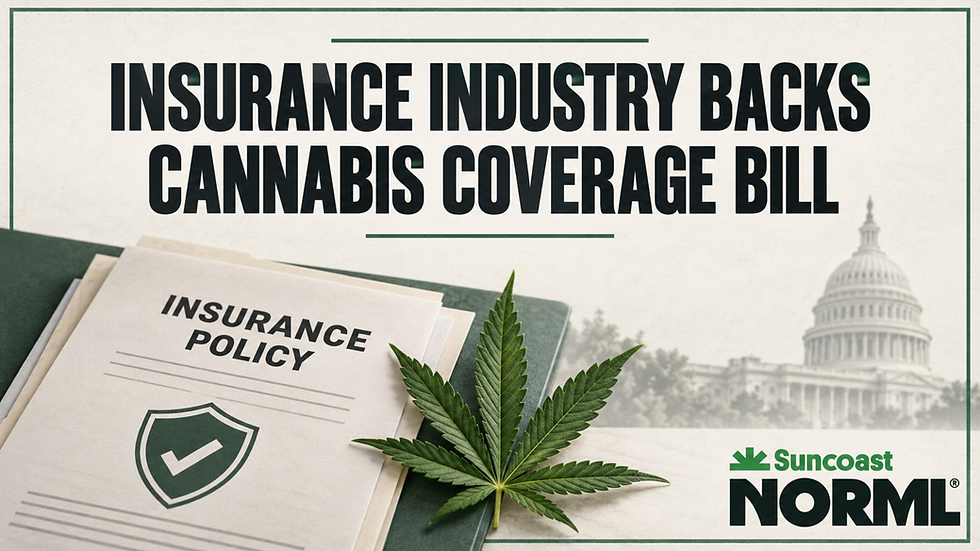
The legal cannabis industry may be one step closer to getting something every legitimate business needs: dependable insurance.
A coalition representing a broad cross-section of the U.S. insurance market has endorsed the Clarifying Law Around Insurance of Marijuana Act, better known as the CLAIM Act. The bipartisan federal proposal would protect insurers, brokers and agents from federal punishment simply for serving cannabis businesses that operate legally under state law.
That may sound like a narrow technical change. It is not.
Insurance helps businesses recover from fires, theft, lawsuits, damaged property and other losses. It can also be a condition for signing a lease, securing financing or doing business with vendors. When legal cannabis operators cannot obtain adequate or affordable coverage, the consequences can reach workers, customers, landlords and surrounding communities.
The endorsement was first reported by Marijuana Moment, which noted that the legislation is intended to resolve the conflict created by state cannabis laws and continuing federal prohibition.
What Is the CLAIM Act?
The CLAIM Act is a bipartisan bill designed to create a federal safe harbor for the insurance industry.
In practical terms, it would prevent federal agencies from penalizing insurers solely because they provide services to a cannabis-related business that is operating legally under state law. It would also protect insurance professionals and employees from federal liability merely for working with such businesses.
The House bill was introduced by Representatives Nydia Velázquez, a New York Democrat, and Warren Davidson, an Ohio Republican. A Senate companion was introduced by Senators Kevin Cramer, a North Dakota Republican, and Ruben Gallego, an Arizona Democrat.
That bipartisan sponsorship is significant. Cannabis policy is often treated as a partisan culture-war issue, but insurance is fundamentally about risk management, consumer protection and ordinary commerce.
Just as importantly, the CLAIM Act would not eliminate state oversight. Insurers would still have to comply with applicable state laws and regulations, including requirements involving claims payments and consumer protections.
Why Insurance Groups Support the Cannabis Bill
Nine national trade associations signed the letter supporting the legislation:
American Land Title Association
American Council of Life Insurers
American Property Casualty Insurance Association
Council of Insurance Agents & Brokers
Independent Insurance Agents & Brokers of America
National Association of Mutual Insurance Companies
National Association of Professional Insurance Agents
Reinsurance Association of America
Wholesale & Specialty Insurance Association
Together, the organizations said they represent most of the companies, agents and brokers providing property-casualty, life, title and reinsurance products in the United States.
Their concern is straightforward: state law may recognize and regulate a cannabis business, but federal law can still treat the underlying marijuana activity as illegal. That contradiction creates uncertainty for companies deciding whether they can safely insure the business.
The CLAIM Act would clarify that providing insurance to a state-legal cannabis operation is not, by itself, grounds for federal punishment.
What Would the CLAIM Act Do for Cannabis Businesses?
If enacted, the bill could make it easier for state-licensed cannabis companies and businesses that serve them to obtain essential coverage.
The proposal would:
Protect insurers, agents and brokers from federal penalties for serving state-legal cannabis businesses.
Prevent coverage from being canceled or restricted solely because a company participates in a legal state cannabis market.
Protect employees of insurance companies from liability based only on their work with a cannabis client.
Preserve state authority over insurance regulation and consumer protections.
Require the Government Accountability Office to study barriers facing minority- and women-owned cannabis businesses, including obstacles involving licensing and financial services.
The bill would not legalize marijuana nationwide. It would not require an insurer to cover every cannabis company, and it would not excuse either the insurer or the insured business from complying with state rules.
Instead, it addresses one specific consequence of federal prohibition: the risk that an insurer could be punished for covering a business that a state has licensed and regulates.
Why Better Cannabis Insurance Is a Public-Safety Issue
Legal cannabis businesses face many of the same risks as other businesses—and some additional ones.
A cultivation facility can suffer a fire or equipment failure. A dispensary can experience theft, storm damage or a customer injury. A delivery operation needs commercial vehicle coverage. Property owners, employees and consumers may all depend on a valid policy when something goes wrong.
Limited competition in the insurance market can mean fewer policy choices, narrower coverage and higher prices. Small and independent operators are often least able to absorb those costs.
More legal certainty could encourage additional insurers to evaluate the market. Greater participation does not guarantee lower premiums, but competition and clearer rules can give licensed businesses more opportunities to obtain coverage suited to their actual risks.
In other words, insurance is not a luxury for the cannabis industry. It is part of the infrastructure of a regulated market.
Why the CLAIM Act Matters to Florida
Florida has a large state-regulated medical marijuana program, but participating businesses still operate under the shadow of conflicting federal law.
For Florida cannabis operators, reliable insurance can affect real estate agreements, business financing, hurricane preparedness, employee protection and the ability to recover after a major loss. Ancillary companies—from landlords and contractors to accountants and equipment suppliers—can also be affected by uncertainty surrounding cannabis clients.
Federal reform that respects state-legal activity would help reduce that uncertainty. It would also reinforce an important principle: businesses that comply with state cannabis regulations should have access to the same basic risk-management tools available to other lawful industries.
Insurance Reform Is Progress, but It Is Not the Finish Line
The CLAIM Act is a practical proposal, but it does not solve the larger contradiction between federal prohibition and the cannabis laws adopted by states across the country.
Cannabis businesses still face federal obstacles involving banking, taxation, bankruptcy protection, interstate commerce and more. Lawmakers have introduced separate measures to protect financial institutions that serve state-legal cannabis companies, but comprehensive federal reform remains unfinished.
It is also important to remember that the CLAIM Act has only been introduced. An endorsement from major insurance organizations may strengthen its prospects, but Congress must still advance and pass the legislation before it can become law.
Still, the coalition's support sends a clear message: the conflict between federal and state cannabis policy is no longer just a problem for cannabis companies. It creates complications for mainstream industries trying to serve customers, follow state regulations and manage risk responsibly.
The Bottom Line
The CLAIM Act would not legalize cannabis, rewrite state insurance laws or force companies to issue policies. It would do something more limited—and immediately useful: protect insurance providers that choose to work with state-legal cannabis businesses.
That change could improve access to coverage, strengthen consumer and worker protections, and help regulated cannabis companies operate more like every other legitimate business.
Suncoast NORML supports replacing the contradictions of prohibition with clear, fair and workable policies. Allowing state-legal cannabis businesses to purchase ordinary insurance is a commonsense place for Congress to start.
Frequently Asked Questions
What is the CLAIM Act?
The Clarifying Law Around Insurance of Marijuana Act is a bipartisan federal proposal that would protect insurers and insurance professionals from federal penalties for serving cannabis businesses operating legally under state law.
Would the CLAIM Act legalize marijuana federally?
No. The bill is focused on insurance services. It would not end federal cannabis prohibition or legalize interstate marijuana commerce.
Would insurance companies be required to cover cannabis businesses?
No. Insurers would retain their normal underwriting discretion and would still have to follow state insurance laws. The bill would remove federal punishment based solely on serving a state-legal cannabis business.
Could the bill help small cannabis businesses?
Potentially. Clearer federal protections could encourage more insurers to consider the market, giving licensed businesses additional coverage options. The proposal also directs the GAO to examine barriers faced by minority- and women-owned cannabis companies.
Has the CLAIM Act become law?
No. The legislation has been introduced in Congress and has received support from major insurance trade organizations, but it must pass both chambers and be signed by the president before becoming law.
Sources and Further Reading
This article is for educational and advocacy purposes and does not constitute legal, insurance or financial advice.
To pick up a draggable item, press the space bar. While dragging, use the arrow keys to move the item. Press space again to drop the item in its new position, or press escape to cancel.


Comments